Devon · EX1-EX6
Drone roof survey in Exeter
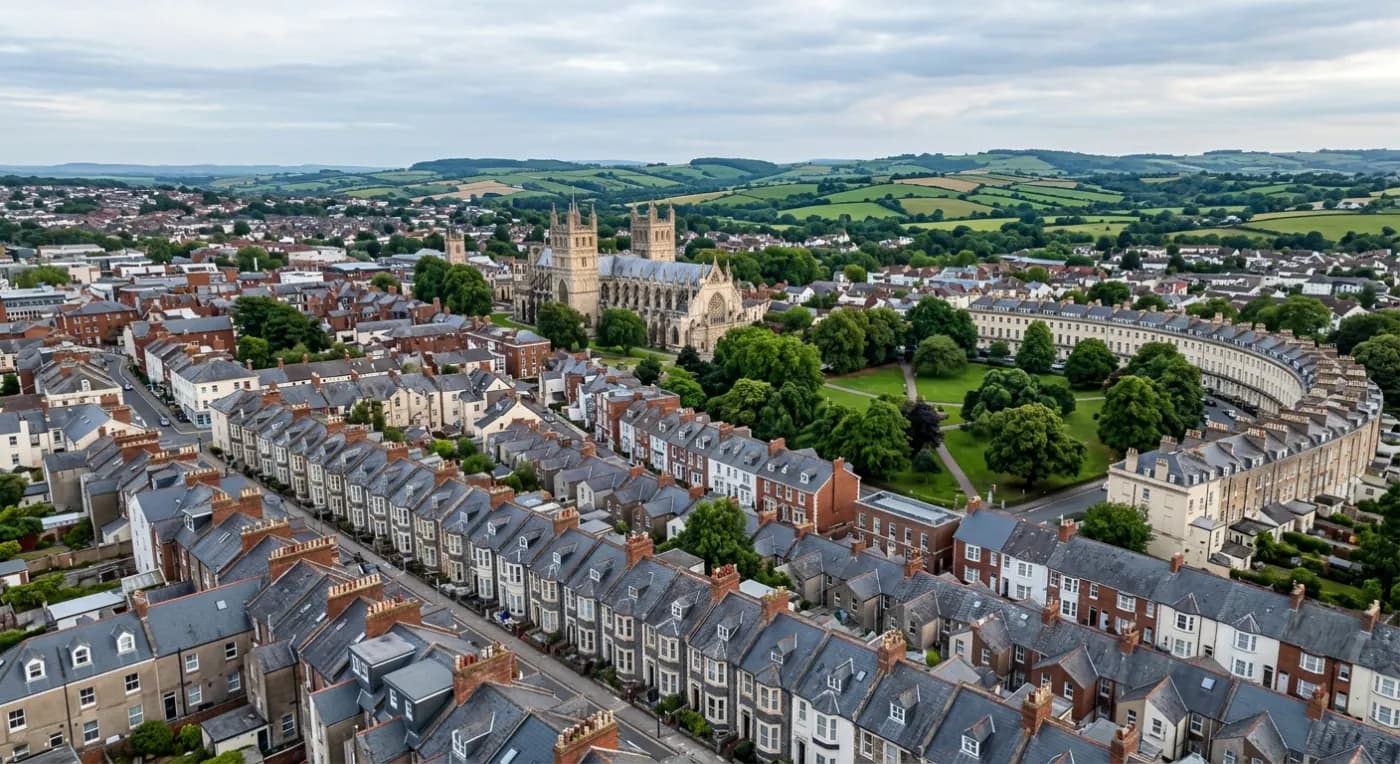
Roof surveys across Exeter, from the Victorian terraces of St Leonard's and Heavitree to the concrete tiled estates at Pinhoe, flown without a scaffold.
Four centuries of roof on one city
Exeter is unusual in how many different roofs sit within a couple of miles of each other. The cathedral quarter and the Georgian streets around Southernhay carry slate behind parapets, with lead gutters running out of sight above the cornice. Push out to Heavitree, St Thomas or Newtown and it becomes tight Victorian terrace: natural slate, shared party walls, brick stacks every few metres, and a lead valley between the main roof and the rear projection on almost every house.
The outer ring is a different building altogether. Post-war estates at Wonford, Whipton and Beacon Heath are concrete interlocking tile on shallower pitches, and the newer development east of the city towards Pinhoe and Cranbrook is the same material again but with mechanically fixed dry ridge systems.
That spread matters because the faults are not the same. A survey of a Southernhay parapet gutter is looking for a completely different failure to a survey of a 1970s ridge line at Whipton, and knowing which building you are over before you take off saves a lot of pointless flying.
Where Exeter roofs actually fail
On the Victorian stock it is nearly always the same three places. The lead valley between the main slope and the back addition silts up with grit and moss until water backs up under the slate. The mortar bedding on the ridge opens, and once it has, the wind gets under the ridge tiles. And the flashing where a stack passes through the slope lifts a fraction, which is invisible from the street and puts water straight into the chimney breast.
On the flat roofs over city centre extensions and shop units, the failure is ponding. Exeter sits in a valley and gets more rain than the England average, so a flat roof that does not drain properly holds water for weeks at a time and the membrane gives up years earlier than it should.
The concrete tiled estates fail differently again, usually at the ridge and the verge, where mortar bedding that was fine for thirty years starts letting go and individual tiles begin to rock in the wind.
Why flying beats scaffolding here
Terraced streets are the problem. Getting a scaffold up on a Heavitree terrace often means a pavement licence, sometimes a partial road closure, and always a conversation with the neighbours either side. It is days of work and a bill in the low thousands before anybody has established whether there is anything actually wrong.
A flown survey needs a lawful launch point and about an hour. In the conservation areas around the cathedral and the quayside, it has the additional advantage of touching nothing at all, which removes the whole listed building consent conversation for a piece of work that is only meant to be a look.
Airspace is worth mentioning. Exeter Airport sits east of the city and there is a flight restriction zone around it, so addresses out towards Clyst Honiton, Sowton and the Airport Business Park get checked properly before a date is agreed rather than on the morning.
Behind the survey
What Exeter clients are actually buying
CAA registered
Operator ID and Flyer ID held, plus the A2 Certificate of Competency. Every flight is planned to the rules that apply to the site, and the paperwork is available before the visit if your agent or insurer wants it.
100 megapixel camera
A DJI Mavic 4 Pro with a Hasselblad camera and 6K video. The resolution is what lets a survey stand off the building at a safe distance and still show a hairline crack in a single slate.
Radiometric thermal
A DJI Mavic 2 Enterprise Advanced carrying a 640 by 512 thermal camera. Used where a leak needs tracing rather than just photographing, because water shows as temperature long before it shows as a stain.
Insured with Coverdrone
Full commercial cover for the operation. Certificates go to managing agents, block committees and insurers as a matter of course, without anyone having to chase for them.
Nearby
Also covered around Exeter
- TopshamRoof surveys in Topsham, where listed merchant houses, Dutch gables and lead detailing sit on narrow streets that a scaffold lorry cannot easily reach.
- ExmouthRoof surveys in Exmouth, where two miles of open seafront and unbroken south-westerlies work on every fixing and flashing faster than anywhere inland.
- CreditonRoof surveys around Crediton, where farmhouses, barn conversions and thatch sit at the end of narrow lanes that a scaffold lorry cannot get down.
- CullomptonRoof surveys in Cullompton, where a medieval thatched core and thirty years of estate building sit on a damp valley floor beside the M5.
- Newton AbbotRoof surveys in Newton Abbot, a low-lying railway town of Victorian terraces where mist off the Teign keeps shaded slopes damp all winter.
Get it looked at
Book a roof survey in Exeter
Send the address and what is worrying you. Sam Hembury will come back with a fixed price and the next slot that suits the weather.