Devon · EX15
Drone roof survey in Cullompton
Roof surveys in Cullompton, where a medieval thatched core and thirty years of estate building sit on a damp valley floor beside the M5.
Thatch in the middle, concrete tile all round it
Cullompton has a sharper split than most Devon towns. The old centre along Fore Street is medieval and Georgian with a significant amount of thatch and cob in the surrounding lanes, and around it sits a very large volume of late twentieth century estate housing, almost all of it concrete interlocking tile.
The two need completely different surveys. On thatch the whole question is the ridge, the coat wear and any vermin damage, and none of that can be assessed from the ground. On a 1990s estate roof the question is mortar bedding, ridge and verge fixing, and whether the tiles have started to rock.
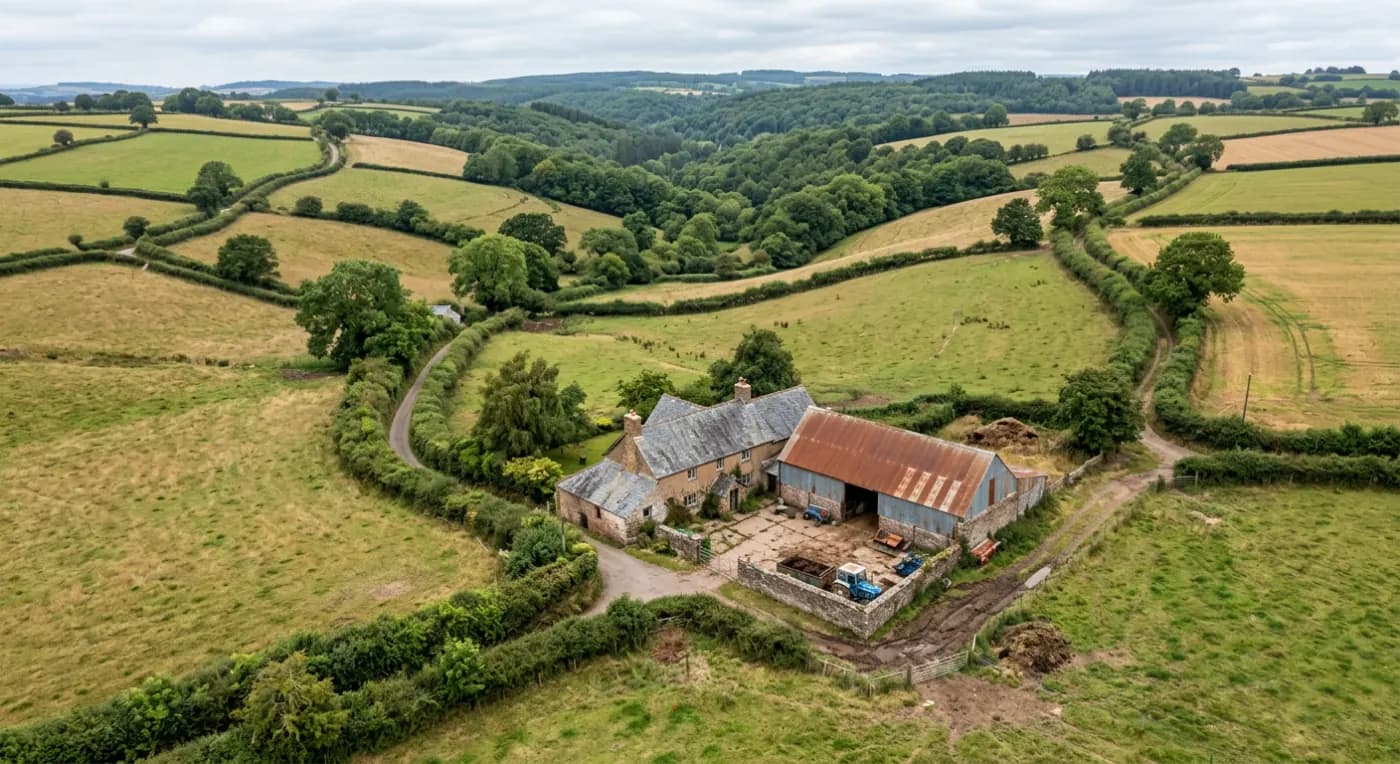
There is a third category worth noting: barn conversions and former agricultural buildings on the edge of town, which often combine original stone or slate with modern materials introduced during conversion, and the junction between the two is where they leak.
A valley floor that holds water and frost
The town sits low in the Culm valley, which makes it damp and frost prone. Cold air drains down into the valley overnight, so Cullompton gets frost when the surrounding higher ground does not, and it gets it more often.
Freeze and thaw on wet mortar is one of the most effective ways of taking a roof apart. Water gets into a mortar joint, freezes, expands and opens the joint a fraction, and the following night it does it again. Over fifteen winters the bedding on a ridge line goes from solid to crumbly, and after that the wind does the rest.
Thatch on the valley floor also stays wetter for longer than thatch on a hillside, which shortens the working life of a ridge noticeably.
New estates are not exempt
There is an assumption that a roof built in the last thirty years does not need looking at. In practice, estate roofs from the 1980s and 1990s are exactly the age where mortar bedded ridges start to let go, and a lot of them were built before dry ridge systems became standard.
The other recurring find on estate housing is workmanship rather than age: a verge that was never properly bedded, a flashing that was cut short at a first floor abutment, or a rooflight installed into a later extension without the correct upstand. Those do not fail for a decade and then fail permanently.
Cullompton also has a good deal of profiled metal sheet on its industrial estates, where the failure is corroded fixings and lifted sheets rather than anything to do with tiles.
Cullompton's position at junction 28 of the M5 also means a good deal of roadside commercial roofing has gone up around the town in the last two decades, alongside the historic core. Large flat and low pitch roofs on units built for logistics and retail age quickly under UV and standing water if nobody is checking them, and from ground level a warehouse roof might as well not exist.
Behind the survey
What Cullompton clients are actually buying
CAA registered
Operator ID and Flyer ID held, plus the A2 Certificate of Competency. Every flight is planned to the rules that apply to the site, and the paperwork is available before the visit if your agent or insurer wants it.
100 megapixel camera
A DJI Mavic 4 Pro with a Hasselblad camera and 6K video. The resolution is what lets a survey stand off the building at a safe distance and still show a hairline crack in a single slate.
Radiometric thermal
A DJI Mavic 2 Enterprise Advanced carrying a 640 by 512 thermal camera. Used where a leak needs tracing rather than just photographing, because water shows as temperature long before it shows as a stain.
Insured with Coverdrone
Full commercial cover for the operation. Certificates go to managing agents, block committees and insurers as a matter of course, without anyone having to chase for them.
Nearby
Also covered around Cullompton
- TivertonRoof surveys in Tiverton, a wet valley town on steep ground where roofs sit above the general roofline and take more wind than their neighbours.
- ExeterRoof surveys across Exeter, from the Victorian terraces of St Leonard's and Heavitree to the concrete tiled estates at Pinhoe, flown without a scaffold.
- HonitonRoof surveys in Honiton, where a uniform Georgian high street conceals a long run of shared roofs, and the valley sits under fog that keeps things damp.
- WellingtonRoof surveys in Wellington, where the Blackdown escarpment immediately south accelerates wind over the town and the mill legacy leaves large span roofs.
Get it looked at
Book a roof survey in Cullompton
Send the address and what is worrying you. Sam Hembury will come back with a fixed price and the next slot that suits the weather.