Devon · PL1-PL9
Drone roof survey in Plymouth
Roof surveys across Plymouth, from post-war flat roofed city centre blocks to Victorian terraces on the hills, with the Sound sending salt inland.
A city of flat roofs and steep hills
Plymouth is two roof problems in one city. The rebuilt post-war centre is dominated by flat and low pitch commercial roofing: asphalt, felt and single ply on wide spans, with parapets, plant, rooflights and long internal drainage runs. Those roofs fail by ponding, seam failure and blocked outlets, and none of it is visible from the street below.
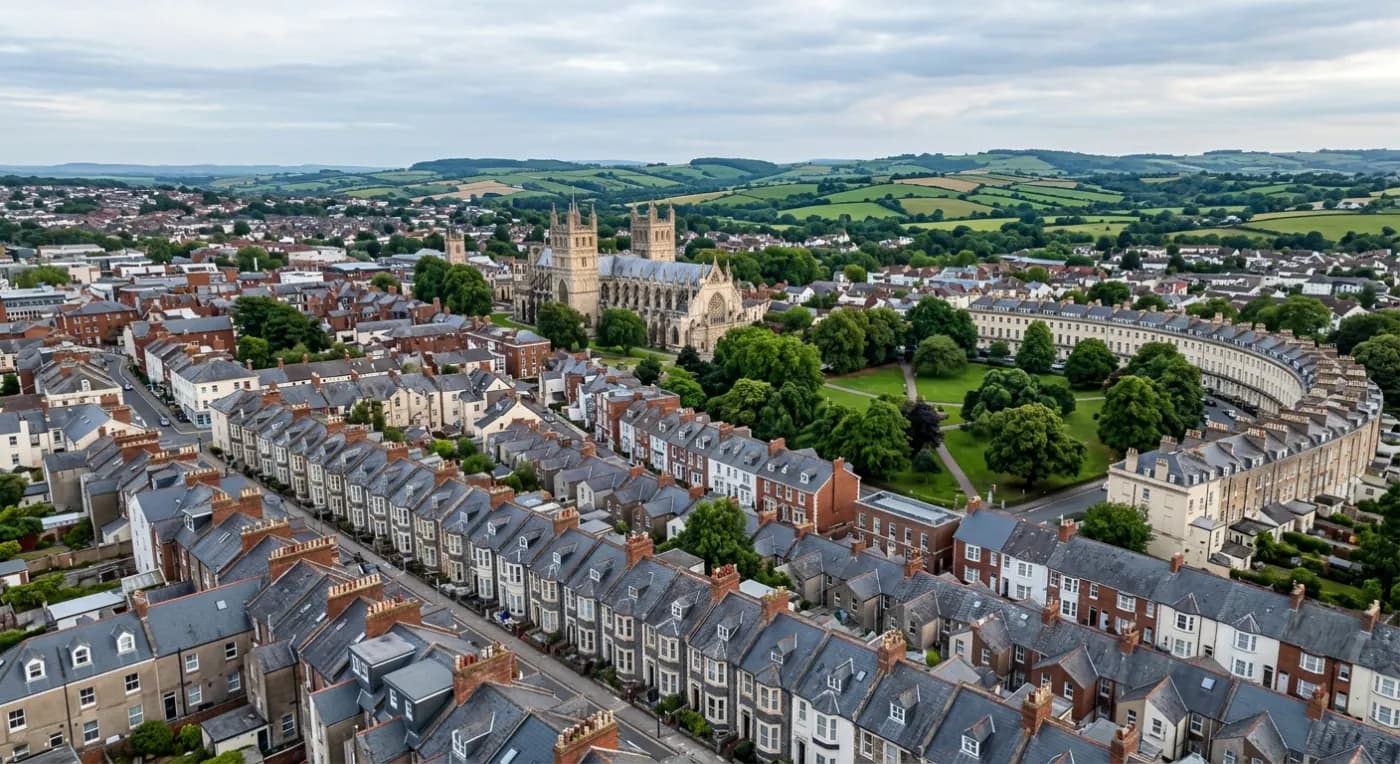
The surviving Victorian and Edwardian stock around the Hoe, Stoke, Mutley and Peverell is the opposite: steep slate, tight terraces, rendered elevations, and brick or rendered stacks in long repeating runs.
Between them sit the large post-war estates at Crownhill, Southway and Ernesettle, mostly concrete interlocking tile, on high exposed ground where the wind gets a clear run at them.
Salt reaches further inland than people expect
The Sound is open to the Channel and south-westerly gales come straight in. Salt does not stop at the waterfront: in a strong blow it is carried well up into the city, and the corrosion effect on fixings, brackets and flashings shows in the higher suburbs as well as on the front.
The Tamar and Plym valleys funnel wind too, so properties along both sides of the city get more than their share, and the limestone ridges the city is built on mean steep streets where one row of roofs stands above the next.
That gradient is a scaffolding problem as much as a weather one. Terraced streets on a slope need levelled bases and additional bracing, and several of the older waterfront streets have no realistic vehicle access for a scaffold lorry at all.
Blocks, freeholders and communal roofs
A large proportion of Plymouth's housing is flats, which means a large proportion of its roofs are communal. That changes what a survey is for: it is not just a technical assessment, it is a document that has to satisfy a freeholder, a managing agent and a group of leaseholders who are being asked to pay for something they cannot see.
Parapet gutters, rooflight upstands, membrane seams and pooling around outlets are the usual findings, and a photograph of any of them settles an argument faster than a paragraph of description.
Surveys of blocks and portfolios get one report per address rather than one report per batch, so it can be filed against the right building and compared against the same building next year.
The Barbican and Sutton Harbour add a further layer to that picture: converted warehouse buildings and waterside developments where an original industrial roof has been adapted for residential or leisure use, often more than once. Royal William Yard is the clearest example of the type, grand naval buildings turned into apartments and restaurants, where the roof now has to perform a job it was never built for and the people responsible for maintaining it are several steps removed from whoever built it.
Behind the survey
What Plymouth clients are actually buying
CAA registered
Operator ID and Flyer ID held, plus the A2 Certificate of Competency. Every flight is planned to the rules that apply to the site, and the paperwork is available before the visit if your agent or insurer wants it.
100 megapixel camera
A DJI Mavic 4 Pro with a Hasselblad camera and 6K video. The resolution is what lets a survey stand off the building at a safe distance and still show a hairline crack in a single slate.
Radiometric thermal
A DJI Mavic 2 Enterprise Advanced carrying a 640 by 512 thermal camera. Used where a leak needs tracing rather than just photographing, because water shows as temperature long before it shows as a stain.
Insured with Coverdrone
Full commercial cover for the operation. Certificates go to managing agents, block committees and insurers as a matter of course, without anyone having to chase for them.
Nearby
Also covered around Plymouth
Get it looked at
Book a roof survey in Plymouth
Send the address and what is worrying you. Sam Hembury will come back with a fixed price and the next slot that suits the weather.