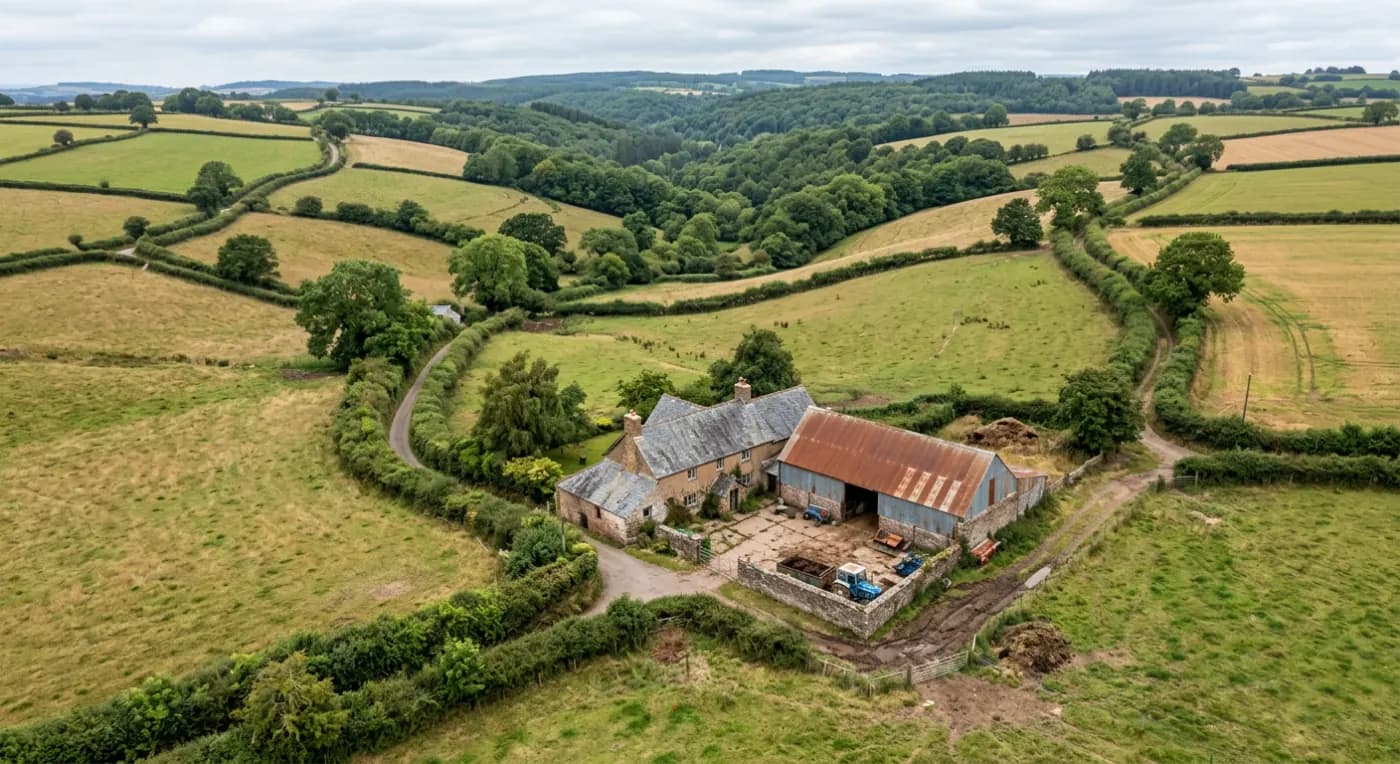
Somerset · TA21
Drone roof survey in Wellington
Roof surveys in Wellington, where the Blackdown escarpment immediately south accelerates wind over the town and the mill legacy leaves large span roofs.
The escarpment changes the wind
Wellington sits directly at the foot of the Blackdown Hills, with the escarpment and the monument on the ridge above it. Air moving over a steep escarpment accelerates as it goes, and it comes down the lee side in gusts and rotors rather than a steady flow.
The result is that the higher streets of the town, closest to the hills, take noticeably more wind than the valley floor a few hundred metres north, and they take it in a turbulent form that works harder on ridges and verges than a steady wind of the same speed would.
Anyone who has lost a ridge tile here and been told their roof was fine tends to have been looking at the wrong part of the roof, because the damage starts at the windward end and works along.
Mill town roofs
Wellington's woollen industry left two things behind: terraced mill workers' housing and very large industrial roofs at Tonedale. Terraced housing behaves as it does anywhere, with shared valleys, party wall flashings and problems that migrate between owners.
The large span buildings are a different job entirely. Long runs of valley gutter that silt up and then back up over the eaves, north light glazing that has gone opaque and brittle, corroded fixings, and coverings that are not safe to walk on. Surveying those from the air is the only sensible approach, because the alternative involves putting weight on a covering nobody has assessed.
Around the town, the modern estates spreading north and east are conventional clay and concrete tile on standard pitches.
Wellington Park and the streets closest to it sit between the mill terraces and the newer estates, a mix of Victorian villas and inter-war semis that took shape as the town grew away from Tonedale. Their roofs are more conventional than the mill buildings but still catch the escarpment's turbulent wind more than a similar street further from the hills would, and it is common to find ridge and verge wear here that a surveyor working purely from a standard exposure rating would not expect.
Somerset materials, Devon weather
Wellington sits on the boundary between the Somerset clay tile tradition and the Devon slate one, and both turn up. That matters because they fail differently: clay spalls and delaminates in frost, slate slips as nails corrode, and the mortar details that hold each in place have different tolerances.
The town also sits close enough to the Devon border to get a good share of Atlantic weather coming over the Blackdowns, so it is wetter than Taunton a few miles north-east.
That combination of frost, wind acceleration and reasonable rainfall makes ridge and verge condition the first thing worth checking on almost any property here.
Behind the survey
What Wellington clients are actually buying
CAA registered
Operator ID and Flyer ID held, plus the A2 Certificate of Competency. Every flight is planned to the rules that apply to the site, and the paperwork is available before the visit if your agent or insurer wants it.
100 megapixel camera
A DJI Mavic 4 Pro with a Hasselblad camera and 6K video. The resolution is what lets a survey stand off the building at a safe distance and still show a hairline crack in a single slate.
Radiometric thermal
A DJI Mavic 2 Enterprise Advanced carrying a 640 by 512 thermal camera. Used where a leak needs tracing rather than just photographing, because water shows as temperature long before it shows as a stain.
Insured with Coverdrone
Full commercial cover for the operation. Certificates go to managing agents, block committees and insurers as a matter of course, without anyone having to chase for them.
Nearby
Also covered around Wellington
- TauntonRoof surveys in Taunton, a drier and more sheltered town than the Devon coast, where the problems are frost, fog and the volume of new estate roofing.
- CullomptonRoof surveys in Cullompton, where a medieval thatched core and thirty years of estate building sit on a damp valley floor beside the M5.
- TivertonRoof surveys in Tiverton, a wet valley town on steep ground where roofs sit above the general roofline and take more wind than their neighbours.
Get it looked at
Book a roof survey in Wellington
Send the address and what is worrying you. Sam Hembury will come back with a fixed price and the next slot that suits the weather.